

At the heart of many modern AI applications are large generative models like large language models (LLMs) or image generation models. These models are trained on enormous amounts of data and can contain billions of parameters. Generative AI (GenAI) has been a transformational technology, excelling in generating content like text, images, code, audio, and video. Consumers and businesses are so enthused by its capabilities that analyst forecasts suggest global spend on GenAI will total $644 billion in 2025, an increase of 76.4% from 2024. GenAI applications are fundamentally reactive systems that respond to instructions or questions by generating new content based on that input and the patterns learned during training. Human users then review, curate, and refine that content to deliver an intended outcome.
We’re now seeing the rise of AI agents. These are AI models trained not only to generate content, but also to execute defined tasks on behalf of users. They are often honed to perform a finite set of tasks, utilizing a defined set of tools and data sources. AI agents have been extremely popular of late, and successful examples include agents capable of autonomously handling customer support inquiries, processing refunds, resetting passwords, writing code snippets, and placing stock orders with suppliers.
The rise of AI agents has led to the exploration of clever ways to combine their powers, creating something greater than the sum of their parts that delivers sophisticated solutions to complex, multi-step problems. This is known as Agentic AI. I know the thought of powers combining has all the 90s kids reading this seeing visions of Captain Planet spawning above the Planeteers. And this analogy isn’t a bad one – each Planeteer (agent) has a single refined power that, when channeled together with purpose, form a powerful superhero (or in our case, a powerful multistep agentic system). Agentic AI is the next frontier, moving beyond just generating content to taking proactive action. Agentic systems are already capable of advanced reasoning and iterative planning to autonomously tackle complex challenges by orchestrating the actions of multiple specialized AI agents. What makes agentic systems so powerful is this orchestration – the ability to selectively use and dynamically coordinate a diverse set of specialized agents to decompose complex objectives into manageable subtasks, sequence actions, and iteratively refine outputs until a satisfactory solution is achieved.
The global AI agents market is projected to skyrocket from around $7.9 billion in 2025 to as much as $236 billion by 2034, reflecting a staggering compound annual growth rate of over 45%. This explosive growth is fuelled by the need for automation, efficiency, and smarter decision-making, where AI agents are revolutionizing workflows and delivering tangible ROI. In fact, 85% of enterprises are expected to deploy AI agents in 2025, underscoring how quickly this technology is becoming foundational for operational excellence and competitive advantage.
As leading organizations leverage AI agents to automate complex processes, personalize customer experiences, and unlock new revenue streams, those who have yet to develop an AI agent strategy risk falling behind in a market where intelligent automation is rapidly becoming the standard for growth and innovation.
Understanding the Power of Autonomous Action
Agentic AI represents the next frontier of intelligent systems that can proactively and autonomously act towards reaching a defined goal. Agentic systems operate on a set of foundational principles, the “Five A’s of Agentic AI”, each capturing a core trait of these remarkable systems that collectively enable them to function autonomously and adaptively within complex business environments.
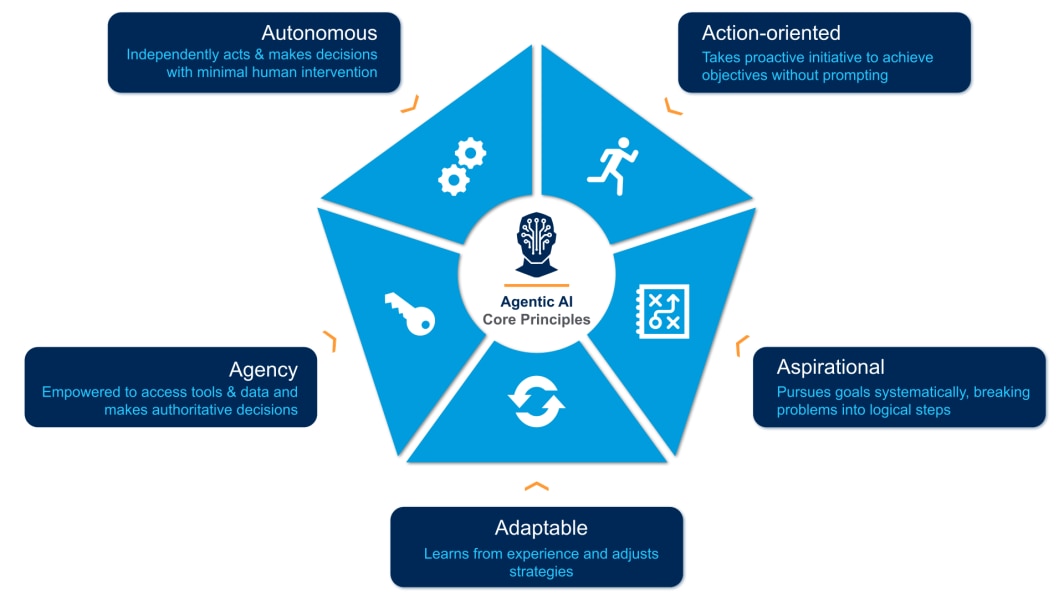
- Autonomous – Operating independently, Agentic AI makes decisions with minimal human guidance. Like a trusted assistant, it assesses situations and acts without needing constant oversight, freeing humans to focus on higher-level tasks.
- Action-oriented – Foregoing the wait for permission, Agentic AI takes proactive initiative, anticipating needs, seizing opportunities, and driving progress without external prompting.
- Aspirational – Goal-oriented to its core, Agentic AI pursues objectives by breaking complex problems into logical, actionable steps. It builds a plan to plot a clear path to success.
- Adaptable – Learning from experience, Agentic AI adjusts its strategies to thrive in dynamic environments and leverages a continuous learning model to adjust to new scenarios or data.
- Agency – Empowered with authority to access tools, data sets, control resources, and make impactful decisions. Whether scheduling meetings or managing data, it wields the power to act decisively within its domain.
Unlike traditional automation, which is limited to predefined, static tasks, agentic AI systems aim to actively perceive their environment, reason through complex scenarios, and autonomously execute multi-step workflows to achieve specific business goals. This should enable agentic AI to deliver transformative value for businesses by driving higher efficiency, smarter decision-making, and lower operational costs.
Powering connected AI
Enabling agentic systems on a global scale will require enterprise-grade architectures that support modularity, scalability, interoperability, and the data transfers required to implement continuous learning strategies. A critical role of distributed cloud architectures is enabling this transition to agentic AI workflows for enterprises, particularly with edge-centric deployments that meet the low-latency threshold required to deliver seamless agent experiences. Deploying modular, scalable agentic applications is similar to deploying modern microservice applications that need to perform with responsiveness in mind, but scale independently. Additionally, being able to assess performance and continually improve requires effective data management. These concepts are explored further in our blog: Distributed AI Inference: Strategies for Success.
Interoperability is essential to enabling agentic AI, allowing seamless integration with diverse enterprise systems and technologies, and enabling access to powerful tools and datasets. This is an area bustling with innovation and rapidly evolving. Several key protocols are emerging to enable seamless connectivity of agents with tools, data sources, enterprise systems, and even other agents, in order to create a dynamic, intelligent network that can facilitate autonomous action.
- Model Context Protocol (MCP), developed by Anthropic, is a popular open standard for secure, two-way connections between AI agents and data sources, business tools, and development environments. MCP is designed to replace fragmented integrations with a universal protocol, enabling agents to access and act on enterprise data efficiently. You can learn more about MCP here and see an example of using MCP on Akamai Cloud here.
- Agent to Agent Protocol (A2A): Developed by Google in collaboration with various other technology partners, A2A provides an open, vendor-neutral standard designed to enable seamless communication, discovery, and collaboration between autonomous AI agents, regardless of the frameworks or platforms on which they are built. It supports multimodal agent communications and coordinated task execution between agents, designed for enterprise-scale workflows.
- Agent Communication Protocol (ACP): Pioneered by IBM Research, ACP provides a standardized framework for agent-to-agent communication, enabling seamless interoperability among autonomous AI agents. ACP provides a common “wire format” for agent-to-agent messaging, task hand-off, and lifecycle management.
In summary, MCP enables agents to connect to external data sources and tools. ACP enables agent-to-agent communication within the same platform ecosystem and enables agent-to-agent communication across different ecosystems, in a vendor agnostic manner. All of these protocols serve to advance agentic systems and are being embraced by the industry.
The Future is Collaborative
The most powerful and impactful AI systems will combine the strengths of both generative and agentic approaches. They will act as intelligent collaborators, understanding when to use generative capabilities to explore options and when to use agentic actions to commit to a course of action and execute complex tasks. Multiple specialized agents will work together, orchestrated by an intelligent ‘leader’ to deliver impressive solutions.
Distributed cloud infrastructure provides the ideal foundation for deploying AI agents within complex, agentic systems. By partnering with Akamai Cloud – the world’s most distributed cloud with an expansive edge network – businesses can build and deliver cost-effective, high-performance AI solutions that scale securely and reliably. With Akamai, enterprises can have confidence that their agentic systems are built for the future, with robust governance and peace of mind.
The future is collaborative. The future is exciting. The future is agentic.
See how Akamai can power your AI workloads at scale. Talk to our experts today.




Comments